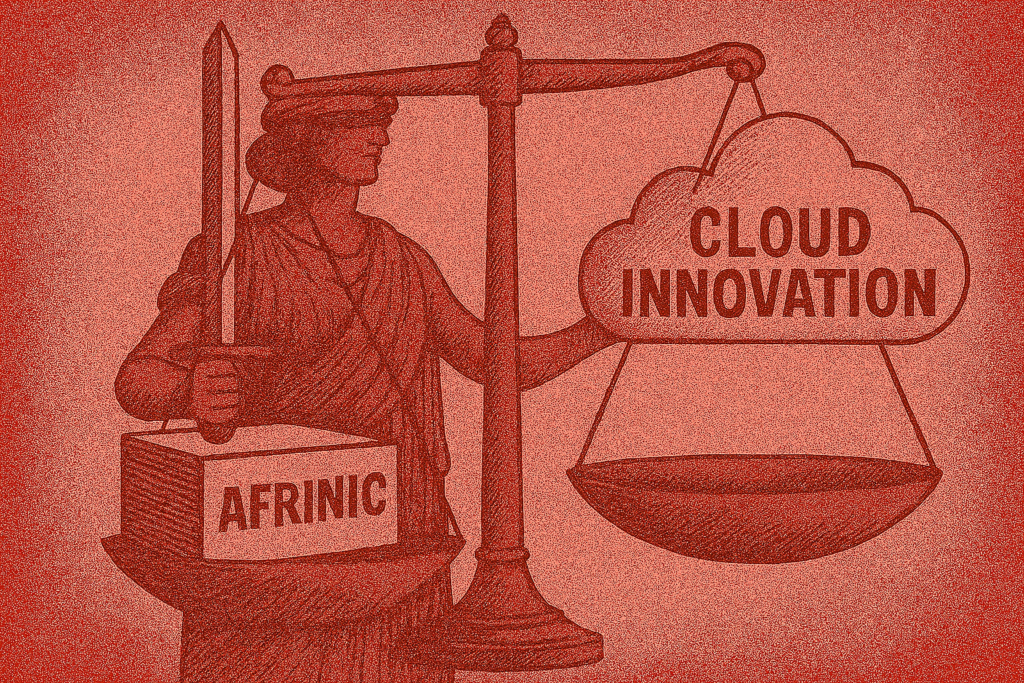
On the morning of July 10th 2025, as the sun rose over the Indian Ocean, something ominous quietly slipped through the pages of a Mauritian newspaper. Tucked between car listings and real estate ads, a terse legal notice stood out like a whisper of death, a winding up petition against AfriNIC. It did not come with press releases or headlines. Just a few clinical lines of text buried in the classifieds, yet they carried the weight of a continent’s digital future. This was no rumour. No courtroom bluff. It was a calculated legal strike filed by Cloud Innovation Ltd, a company that has circled Africa’s regional internet registry for years with the patience of a predator and the timing of a trapper. Now it has pounced.
The notice appeared under the seal of the Supreme Court of Mauritius. Dated 9 July, it announced that a petition had been filed to wind up the African Network Information Centre. The hearing was scheduled for 24 July. The public was invited to object. Creditors were told to come forward. A generic email was listed for submissions. There was no context. No urgency. No sense that what had been set in motion was more than procedural. No hint that the question on the table was not only legal, but existential. AfriNIC was named as the respondent. Not described. Not acknowledged as the continent’s only Regional Internet Registry. Just another party. Just another file in the machinery of a system that treats digital infrastructure as if it were an ordinary commercial dispute.
But AfriNIC is not an ordinary company. It does not sell coconuts. It does not trade SIM cards. It does not export sugar. It assigns IP addresses, the digital coordinates that allow African networks to exist online. It does not provide internet. It makes internet presence possible. Without AfriNIC, the continent’s networks lose their technical identity. Routing becomes uncertain. Sovereignty weakens. To dissolve it is to cut the wire that lets Africa speak for itself in the global digital conversation. The petition made no mention of that. The language was clinical. The form familiar. A legal reference. A lawyer’s signature. And at the bottom, an office address in Port Louis called Happy World House.
No statements were issued. No outrage expressed. But those who understand how the internet is built saw the signal. The long siege had reached its final phase. Cloud Innovation had filed complaints. Paralyzed meetings. Disputed elections. Frozen accounts. It had spent years tightening the grip. This filing marked the moment when pressure turned to strike. And it struck not inside the courtroom, but through the public notice section of a newspaper.
This is no routine business disagreement. It is a calculated blow to the only internet registry based on African soil. AfriNIC does not exist for profit. It was never built to compete. It was built to coordinate. It assigns the technical resources that make regional connectivity possible. Bringing it down would be more than administrative. It would be symbolic. A dismantling of one of the last public-interest institutions standing in the digital space.
You do not need a law degree to understand what is at stake. You only need to have lived long enough in Africa to recognise the script. Institutions fade here not because they are flawed by design, but because they are betrayed in silence. Air Afrique collapsed. Africa N°1 went quiet. And the final act rarely came from outsiders. It came from within. From hesitation. From fatigue. From local hands holding the door open.
AfriNIC now faces the same threat. But this time, the assault is dressed as law. Section 180 of Mauritius’ Insolvency Act is the tool. But the petition is not a cry for relief. It is a declaration of intent. This is not a quest for balance. It is a move to erase. The court becomes a theatre. The registry, a carcass.
Yet AfriNIC is not dead. Its systems still operate. Partnerships still hold. The mission still echoes across networks and institutions trying to chart Africa’s digital path. It has been weakened. But it breathes. And that breath matters. Because this is not about a debt. It is about a legacy. It is about whether a continent can keep what it has built, even when it is imperfect. The filing is not a neutral act. It is a political signal. And it demands a political response. How far should a court go when what lies in the balance is not only one institution, but an entire model of governance.
To close AfriNIC would not be like shutting down a failing shop. It would be like burning a library because someone forgot to pay the light bill. The damage will not be instant. It will seep in. Through broken allocation paths. Through declining trust. Through the rise of actors with no roots on the continent and no stake in its development. The void will not last. It will be filled. But by whom. And for what purpose.
The registry is breathing, but the knife is legal
You do not need a black robe, a wing collar or a powdered wig to understand what this really is. You only need to recognise what happens when African institutions are left to sink in silence. This is not only about AfriNIC. It is about what has already been lost. Every time a public institution has collapsed on this continent, the warning signs were there. Budgets stretched thin. Political backing gone quiet. Supporters watching from a distance. And when the final blow landed, it rarely came from the outside. It came from within. From private deals. From shared silences. From hands that opened the gate before the attacker ever reached it.
Now the wolf is back. But this time it does not come with claws. It carries a court document and speaks the language of legal form. It does not wait in the shadows. It walks straight through the front door, quoting section 180 of the Insolvency Act, asking the judge to finish what the slow siege began. Not with force. With a pen.
There is nothing fair about it. No cry for justice. This is not a wounded actor seeking balance. It is the final move in a strategy designed long ago. A cascade of lawsuits. Election disputes. Asset freezes. Assemblies derailed. Mediation refused. Cloud Innovation has used every tool to weaken the registry from the inside. The petition is just the final blow.
And let us name the actor. This is not a local company. It is a firm controlled by a Chinese businessman, Lu Heng who has spent years exploiting procedural gaps to bend the system to his advantage. It is the work of a soft-spoken man with a foreign passport and a tailored suit. A wolf who does not snarl. He smiles. He speaks calmly, always politely. But every word is measured. Every move calculated. He is not here to participate. He is here to own. And he does not need to knock down the door if the court will open it for him.
But AfriNIC is not dead. It has taken hits. Its board is paralysed. Its finances are blocked. But its servers still function. Its staff still managing resources. Its mission still carries weight. It is wounded. But it is breathing. That is why this petition cannot be seen as a financial process. It is a political act dressed in the clothes of commercial law. It is not about insolvency. It is about sovereignty. It is not about unpaid bills. It is about who controls the foundation of Africa’s internet.
This moment raises a question no court should answer alone. Can a public interest institution be dismantled like a failed business. Can a registry that serves a continent be wound up because one foreign actor was allowed to game the system. Should such decisions happen in silence while the region watches, confused or unaware. AfriNIC is not a store. It is not a supplier that can be swapped out for another. It is a cornerstone. It holds the naming and numbering system of a continent’s digital presence. If it falls, the damage will not be immediate. But the cracks will spread. Address duplication. Routing conflicts. Institutional confusion. New actors with no regional roots will fill the vacuum. But not with the public interest in mind.
The law may be blind. But justice must see the bigger picture
The legal questions are many, but the historical lessons are louder. When a star goes out, the sky does not go dark all at once. But it does begin to lose its bearings. And when institutions collapse without resistance, it is not because no one saw it coming. It is because those who should have stood up chose to look away. Governments cannot now claim they did not know. Silence is no longer a shield. Ignorance is no longer an option.
What is unfolding is not an elite dispute. It is not a fight between executives. This is about the digital sovereignty of an entire continent. It is about public hospitals that rely on network stability, schools that need online platforms, payment systems that depend on IP allocations, databases that must remain visible and secure. This is about digital identity. This is about national planning. This is about the architecture that lets an African state speak and be heard online.
AfriNIC is not a theoretical construct. It is a functional institution. It is the mechanism that allows African networks to be recognised, routed, and trusted. It is the quiet engineer behind the scenes, ensuring that when a government agency launches a service, or a university connects a campus, or a startup deploys an app, the world can see it, find it, and interact with it. You cannot wind that up without consequences.
And so, when the wolf comes through the gate, the village must wake up. We cannot go on counting kola nuts while the granary burns. We cannot wait for instructions. We cannot act like bystanders. This fight will not be won in expense claims or late-night side meetings. It will be won in clarity. In courage. In the refusal to let due process be used as a blade against the public good.
AfriNIC is still standing. Just barely. And if no one helps it hold its ground, then let no one say tomorrow that they did not know. The signs are all there. The smoke is visible. The legal attack has begun. What is needed now is not another round of meetings. It is a response grounded in responsibility and urgency.
The winding-up petition is not just a legal tool. It is a test. Of what African institutions are worth. Of whether governments will defend what they helped build. Of whether we still know the difference between what is ours and what we have already lost.
Justice is still dressed for the role, but the gavel is hollow
Sometimes, it takes watching a scavenger circle a weakened lion to realise just how far justice can be twisted into spectacle. What is happening to AfriNIC is no longer a legal matter. It is theatre. A carefully staged production where the plot is power and the costumes are stitched from robes that once symbolised justice.
When I wrote publicly about Cloud Innovation and its campaign against AfriNIC, the response came swiftly. Not with debate. Not with evidence. But with threats. Cease and desist letters landed in my inbox, not drafted by seasoned professionals but by someone playing lawyer with templates. The language was clumsy. The logic thinner than smoke. The goal was not to correct facts but to intimidate. To force silence through repetition. The letters came like spam. No precision. No context. Just pressure. Harass enough people, and someone might back down. That was the calculation. But I am not the one on trial. AfriNIC is.
Inside the courtroom, the real show is underway. There, legal process is being weaponised with a straight face. What should be the slow deliberation of justice has become a ritual, drained of meaning. The judges wear their gowns, but they no longer preside over arguments. They oversee a script. Each filing reads like a tired monologue. Each proceeding folds into the next. There is no sense of urgency. Only the soft hum of something being buried alive.
Cloud Innovation does not want resolution. It wants submission. The winding up petition is not a plea for fairness. It is the closing act of a long “4D strategy”. Delay. Distract. Drain. And finally, dissolve. This is not about insolvency. It is about conquest through exhaustion. A test of how much silence a system can tolerate before it collapses.
The registry is not being dismantled because it failed. It is being targeted because it stands. Because it still has a name. Because it still represents an African-built infrastructure that answered to no foreign master. That is what the winding up aims to erase.
And the language used to justify it is even more cynical. Cloud Innovation invokes the idea of fairness. It speaks of justice. It leans on clauses like “just and equitable” as if context were irrelevant. As if dissolving the backbone of a continent’s internet could be compared to closing a shop with unpaid rent.
But AfriNIC is not a vendor. It is a registry. It holds allocations. It carries legitimacy. It underpins everything from universities to government systems. To wind it up is not to settle a dispute. It is to take a match to twenty years of institution-building. It is to invite chaos under the illusion of order.
The most dangerous thing about this process is how routine it looks. A few signatures. A scheduled hearing. An empty courtroom. The whole thing drifts along like a forgotten file. But make no mistake. This is a page being torn from the history of African digital governance. Not loudly. Not violently. But precisely. Deliberately.
What Cloud Innovation wants is not compensation. It wants a precedent. That even the most crucial institutions can be destroyed, not through war, not through scandal, but through procedure. That the house does not have to burn, so long as it can be quietly sold. And if we let it happen this way, then we are not watching a court decision. We are witnessing an execution carried out in silence.
This battle will not be won in court filings alone
There comes a point when silence is no longer a posture. It becomes complicity. What is happening to AfriNIC is not just a legal case. It is a political moment. And the people who claim to lead Africa’s digital future must decide whether they will watch it be dismantled in real time or stand up to defend it.
Governments can no longer hide behind procedural neutrality. They can no longer pretend this is an internal dispute or a matter for courts alone. AfriNIC is not a private firm with limited impact. It is a regional institution. It holds together a portion of Africa’s digital sovereignty. What is being decided is not just whether it stays open. It is whether any African infrastructure can stand without external permission.
This is not about choosing sides. It is about recognising stakes. This is not about backing an executive or a board. It is about protecting what the continent built. A registry born out of vision, defended through storms, and now under siege in broad daylight.
Mauritian law allows states and institutions to intervene in the process. That door is open. The question is whether anyone will walk through it before it closes. The petition for winding up is not just a legal act. It is a dare. It is a challenge to every ministry, every agency, every commission that claims to care about digital sovereignty. It asks them whether they are willing to let the future be written in someone else’s hand.
And it is not just states that must answer. Civil society must not remain observers. The universities. The engineers. The builders of networks. The alumni of governance schools. The former board members. The citizens who know what it means to lose a public good. They must all rise now. Not for AfriNIC alone. But for the principle it represents.
We need a defense front. Not another platform. Not another conference. A real coalition. Agile. Non-partisan. Driven by the urgency of the moment. Something that can document the story, alert the press, speak to the courts, and if necessary, refuse to comply with the slow march toward institutional erasure.
Because this battle will not be won in court filings alone. It will be won in narrative. In collective memory. In the ability to explain, again and again, what AfriNIC is, what it does, and what will be lost if it disappears. This is not just about internet governance. It is about the right of Africans to build and defend the architecture of their future.
The silence must end. AfriNIC cannot be made to sing a swan song, not now, not ever.
If AfriNIC falls, let no one rewrite the story. Let no one say it collapsed on its own. Let no one pretend the silence was accidental. Because this will not only be the winding up of a registry. It will be the erasure of a memory.
The story must be written while the servers still hum. While the names are still fresh. While the actors have not yet disappeared behind the curtains of impunity. We need the archives. The transcripts. The witness statements. The internal minutes. The timelines. Not for drama. For history. Because if this collapse goes undocumented, it will be repeated. And next time, there may be no one left to speak.
This is why we must refuse the comfort of forgetting. The media may grow cold. The funding may dry up. The urgency may fade. But the memory must not. We need to write this moment into books. Into classrooms. Into the syllabi of governance schools. We must turn it into case studies. Into civic lessons. Into the quiet anger of citizens who refuse to let this happen again.
If the mainstream platforms will not carry the story, we will build our own. Podcasts. Bulletins. Roundtables. Underground newspapers if needed. The memory must circulate. Because memory is power. Especially when the law begins to falter.
And we must name the betrayal. The ones who helped break the roof from within. The ones who knew better and stayed quiet. The ones who signed away accountability in dimly lit offices. The ones who traded institutional integrity for career favours and future contracts. They will not be forgotten. Not out of vengeance. But because no community can rebuild without first understanding who poured oil on the stairs as the house began to burn.
Cloud Innovation is not shooting at an ambulance. It is draining the fuel, stealing the wheels, and posing for photographs as a public servant. It is feeding off the collapse while claiming to rescue. And if it finds local agents willing to carry the bag, willing to sell loyalty for a promise of relevance, then those agents must be recognised for what they are. Not pawns. Not naïfs. But accomplices. Strategic collaborators. The stone in the shoe. The crack in the dam.
Yet even now, the fire is not complete. There is still breath. Still resistance. Still a voice. Africa can still refuse. It can still stand. It can still rewrite this not as an obituary but as a turning point. Because what is at stake is larger than AfriNIC. It is about whether we still believe in our capacity to defend what is ours. To nurture institutions. To correct them when they falter. To protect them when they are under attack. To pass them on when we are gone. The continent cannot afford to let this collapse be silent. It must choose what story it will tell.
If AfriNIC is to rise again, it must be from the embers of vigilance, not the ashes of indifference
There are mornings when Africa wakes up with a weight in its chest. Not from fatigue, but from the quiet panic that comes when institutions begin to tremble and no one knows who will catch them. AfriNIC is not just a registry. It is a marker. A beacon. A reminder that even when the path was dark, we chose to build something of our own. And now, they want to extinguish that light. Not through scandal. Not through scandal. But through process. Through a petition dressed up as inevitability. Through silence disguised as formality.
But there are still watchers on the hill. Women and men who know this is not a crisis of management. This is a test of memory. This is not about a board or a staff. It is about a generation refusing to be exiled to the edges of the internet, refusing to be seen only as users of platforms made elsewhere. It is about our right to shape. To steward. To stay present.
This is the moment to gather the scattered. To summon what remains. To bring together engineers and researchers. Elders and students. Civil servants and poets. To speak in one voice and say clearly: this registry is part of our common heritage. It cannot be sold. It will not be dissolved without resistance. In classrooms. In ministries. In villages. In tech hubs and rural schools. On community radio and in quiet cafés. We must teach what an IP address means. What infrastructure sovereignty looks like. Why names and numbers are not abstractions, but power. Visibility. Voice.
The next generation must know that this digital space we navigate can also belong to us. That it is not an empty field left to vultures. It is a living ground that can be seeded. Coded in Swahili. Documented in Bambara. Routed in Wolof. And this dream will never survive if the roots are pulled out while we are looking away.
If the winding up of AfriNIC proceeds, it will not be just a legal defeat. It will be a political funeral. A public pyre set in the heart of Mauritius, burning one of the last remaining institutions that still carried a truly Pan-African mandate. And if a judge chooses to sign that order, then let the ink weigh heavy. Not just as a formality, but as a mark in history. A name that future generations will not find in legal books, but in bitter songs sung in quiet defiance.
But the pen has not yet touched the page. The door is not fully closed. There is still breath in the body. There is still rhythm beneath the silence. And that is enough. Enough to act. Enough to organise. Enough to remember why we built this house in the first place.
Until the lion learns to speak, the tale of the hunt will always glorify the hunter
This is not over. Nothing is sealed. There is still a sliver of light beneath the door. There is still time to make the registry breathe again. But doing so will take more than outrage. It will take courage. Coordination. Humility. And above all, vision.
It will require that we look beyond our own cables and connections. Beyond our networks and titles. Beyond our companies and institutions. It will demand that we think as a continent. That we act as stewards of something larger than ourselves. That we reclaim the right to shape our own digital architecture.
And if that effort must begin somewhere, let it begin here. Let it begin now. With a petition. With a motion. With a public letter. With a unified front. With a message that cannot be misread. To those who would dismantle this house, you will not pass. Not without resistance. Not without Africa speaking. Not without those who still watch the night reminding the world that we are not asleep.
We have watched RASCOM, Africa’s first satellite project, fall into delay and dependence not because the technology was beyond reach, but because the continent failed to move with one voice. We have watched Panapress go silent not for lack of stories to tell, but because the will to sustain our own narrative vanished. We must not watch AfriNIC disappear for lack of courage. The witnesses of a fall are always more numerous than the builders of what comes after. But history belongs to the builders.
The one who sells the village well for a single bucket of water betrays the thirst of the entire people. The one who closes his eyes while the granary is looted should not be invited to the feast. There will be accounts to settle. Not out of revenge, but out of responsibility. To explain to the children who will one day ask why we allowed a foreign actor to dissolve an institution built by our own hands.
But nothing is lost yet. The story is still in motion. This struggle is not just about law. It is about resilience. It is about memory. It is about refusing to kneel while something essential is erased.
AfriNIC can still stand. And with it, the right to name. The right to connect. The right to exist in the global digital space without asking permission. As the Togolese say, when the roots are deep, the storm cannot break the tree. Aluta continua. Aluta continua. Aluta continua!